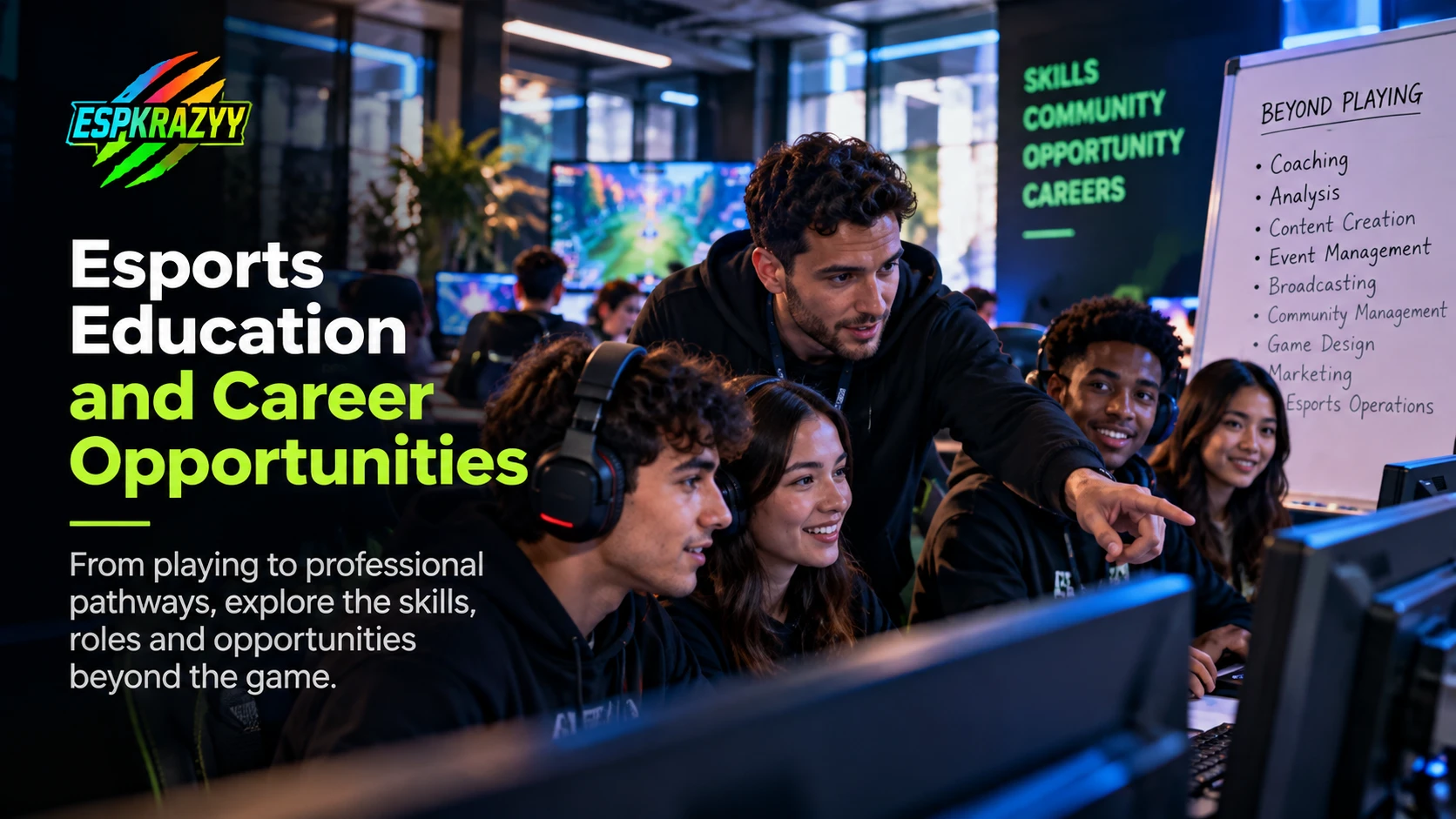
Ask someone about careers in esports and the first answer is often professional gaming. But behind every major tournament, competitive team, livestream and gaming community is an entire network of people whose careers have little to do with playing professionally.
From event production and broadcasting to marketing, coaching, digital content and community management, esports brings together skills from many established industries.
As competitive gaming continues to develop, education and professional development deserve a more prominent place in discussions about its future.
The real opportunity is not simply to create more professional players. It is to help people understand the wider skills, responsibilities and career pathways associated with the esports ecosystem.
The Professional Player Is Only One Part of Esports
Professional players are among the most visible people in competitive gaming. Their performances attract audiences, establish rivalries and inspire others to improve.
However, professional competition represents only a small part of the activity required to support the industry.
Events need organisers. Broadcasts need production teams. Communities require moderation and leadership. Commercial organisations depend on marketing, administration, technology and financial management.
Even relatively small esports activities involve responsibilities beyond gameplay.
A student organising a competition may need to develop a schedule, communicate rules, coordinate participants and resolve disputes. Someone producing a community broadcast must understand equipment, presentation, timing and audience engagement.
These experiences demonstrate an important principle: esports can introduce people to professional skills even when they have no intention of becoming professional competitors.
Esports Education Should Go Beyond Gaming Skills
Education connected to esports should not be limited to improving mechanical ability, strategy or competitive performance.
Those skills have their place, particularly for students interested in coaching, performance analysis and organised competition.
But esports can also provide a practical context for learning subjects that have applications far beyond gaming.
Consider the responsibilities involved in organising a small esports event.
Participants may need to prepare budgets, create promotional materials, organise schedules, manage registrations, coordinate volunteers and evaluate feedback.
These activities connect directly to project management, communication, digital marketing and event operations.
Similarly, esports broadcasting introduces concepts associated with media production, graphic design, presentation and technical coordination.
When these activities are supported by clear learning objectives and appropriate guidance, they can become valuable educational experiences.
The distinction matters. Playing games does not automatically deliver educational outcomes. The value comes from how participation is structured, supported and reflected upon.
Career Pathways Across the Esports Industry
The esports ecosystem intersects with a range of professional disciplines. Understanding these connections can help students and aspiring professionals explore pathways that match their interests and existing abilities.
Event Management and Tournament Operations
Competitive events require planning, scheduling, participant communication, logistics and operational coordination.
Professional event management also involves budgeting, risk assessment, stakeholder relationships and problem-solving.
These capabilities are relevant to traditional sporting events, conferences, entertainment productions and other organised activities.
Broadcasting and Media Production
Esports broadcasts involve commentators, producers, technical operators, video editors, graphic designers and production coordinators.
Developing experience in these areas can introduce people to broader media and entertainment careers.
Knowledge of audio production, editing software, storytelling and live presentation can be useful well beyond competitive gaming.
Marketing and Digital Content
Esports organisations communicate with their audiences through websites, social media, video content, newsletters and community channels.
Creating effective content requires editorial judgement, audience understanding, design, communication and analytical skills.
These capabilities overlap substantially with digital marketing and media roles across many industries.
Community Management
Gaming communities need people who can encourage constructive engagement, manage communication channels and establish clear behavioural expectations.
Community management involves more than keeping a conversation active.
It requires moderation, conflict resolution, planning, consistency and an understanding of how different participants interact.
These skills can also be relevant to online education, customer communities, digital platforms and other community-led organisations.
Coaching and Performance Analysis
Coaching combines game knowledge with communication, preparation, evaluation and interpersonal skills.
Effective coaches must help individuals and teams understand their performance while maintaining realistic expectations and supporting player wellbeing.
Performance analysis may also involve research, data interpretation, observation and the ability to communicate complex information clearly.
The professional opportunities available in these disciplines vary by game, region and the maturity of the surrounding competitive ecosystem.
The Importance of Transferable Skills
One of the most constructive ways to approach esports education is through transferable skills.
Not every student involved in esports will pursue employment in the gaming industry. Nor should that be the only measure of success.
Experience gained through organised activities may support development in communication, teamwork, leadership, planning and digital literacy.
These abilities can be valuable in many professional environments.
However, it is important to distinguish participation from demonstrated competence.
Being part of a team does not automatically make someone an effective leader. Creating a social media account does not necessarily establish professional marketing expertise.
Meaningful development requires practice, feedback and the opportunity to take responsibility for real outcomes.
Educational programmes should therefore focus on what students can demonstrate, not simply how much time they spend gaming.
Grassroots Esports as a Learning Environment
Grassroots esports can provide an accessible starting point for exploring these skills.
Community competitions, school activities and student-led projects offer opportunities to experience the organisational side of competitive gaming.
Participants may begin by helping with registrations, creating promotional graphics, coordinating teams or assisting with event communication.
Over time, these activities can develop into more substantial responsibilities and practical portfolios of work.
Such experiences can be especially useful when supported by teachers, mentors or experienced organisers.
Our article Why the Future of Esports Begins at Grassroots Level explores why accessible participation and strong communities matter to the wider esports ecosystem.
From an educational perspective, the same grassroots environments can provide opportunities to learn through collaboration and practical experience.
Mobile Esports and Wider Access to Opportunity
Access to equipment can influence who participates in esports-related learning.
Programmes dependent on expensive computer hardware may be difficult to establish in communities with limited resources.
Mobile competitive gaming can offer an alternative starting point where smartphones are already widely used.
Although mobile participation brings its own technical and connectivity challenges, it can introduce people to teamwork, community coordination, content creation and competitive organisation.
As explored in Mobile Esports and the Accessibility Revolution, access to technology is only one part of meaningful participation.
Educational opportunities also depend on guidance, inclusion, reliable infrastructure and suitable activities.
The Industry Must Be Realistic About Employment
Enthusiasm for esports careers should be balanced with an understanding of the industry’s commercial realities.
Competitive gaming attracts attention and ambition, but employment opportunities can be highly competitive, geographically concentrated and dependent on uncertain business conditions.
Job titles do not always represent established career pathways, and the availability of permanent positions varies across organisations and markets.
Education providers should avoid suggesting that participation in an esports course guarantees employment in professional gaming.
Instead, students benefit from transparent information about the skills being taught, the relevance of qualifications, opportunities for practical experience and the wider industries in which those skills may be useful.
A student interested in video production, for example, should understand how those abilities apply to media and communications roles beyond esports.
Similarly, someone exploring event management should be encouraged to develop knowledge relevant to multiple types of live and digital events.
This broader perspective can make esports education more resilient and professionally valuable.
Partnerships Between Education and Industry
Education providers and esports organisations have an opportunity to contribute to each other’s development.
Industry professionals can offer insight into operational requirements, evolving technologies and the practical realities of working in competitive gaming.
Educational institutions can provide structured learning environments, research capabilities and opportunities for students to explore emerging disciplines.
Constructive collaboration might involve guest lectures, supervised projects, portfolio reviews, mentoring and practical event experiences.
However, such relationships should be evaluated according to their educational value rather than their promotional visibility.
Students should gain meaningful knowledge and experience, while institutions maintain appropriate standards of safeguarding, inclusion and academic integrity.
Building Opportunities Beyond the Game
Esports education is most valuable when it helps people recognise possibilities beyond professional competition.
For some participants, those opportunities may involve coaching, broadcasting or working with an esports organisation.
For others, competitive gaming may provide an introduction to media production, communication, technology, leadership or event management.
Neither outcome should be considered more legitimate than the other.
A healthy esports ecosystem benefits from talented players, responsible community leaders, skilled professionals and people who contribute in many different capacities.
The industry’s long-term development will depend not only on the games people play, but also on the people capable of organising, supporting and improving the environments around them.
The future of esports careers is bigger than becoming a professional player. It is about turning genuine interests into useful skills, meaningful experiences and realistic opportunities.
ESPKrazyy explores the people, communities and professional pathways shaping competitive gaming. Read more in our Education & Careers and Insights sections.